SouJava Brasília at SESI Lab: When the Community Becomes a Showcase for Those Who Are Truly Building
On July 8, 2026, SouJava Brasília held another in-person
meetup, this time at SESI Lab, in a different, more open, and very special
format: a project showcase.
The idea was simple, but powerful: to create space for people from the community to present
what they are building, exchange ideas, answer questions, show code, talk about architecture,
technology, career, and, above all, give visibility to real projects.
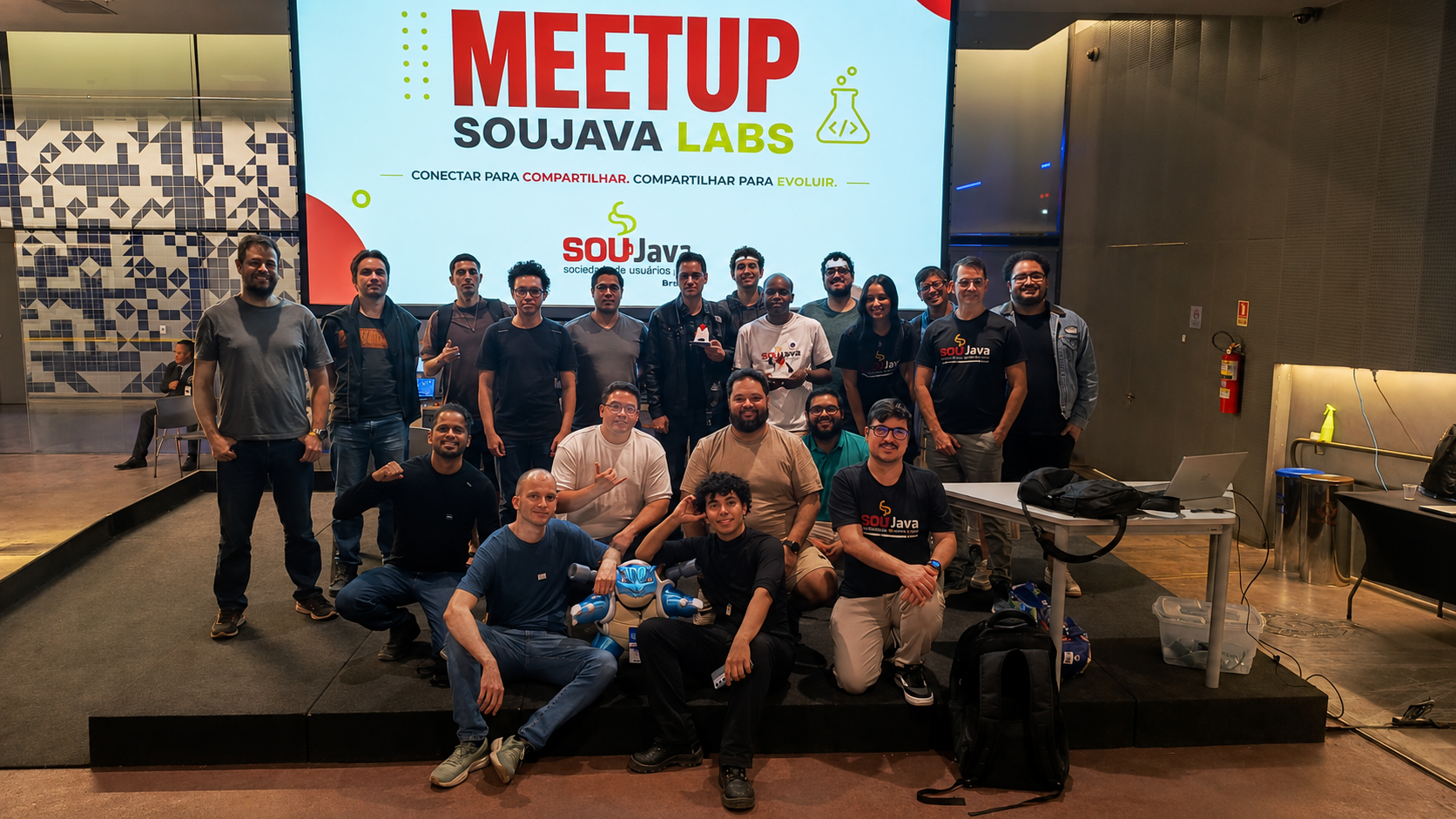
And that is exactly what happened.
The meetup featured project islands, quick presentations, technical conversations, a coffee break,
and a talk by Bruno Rozendo about MVP.
But, for me, the strongest point of the night was something else: seeing students, especially those
in the final stage of their degree, presenting projects with a level of maturity far beyond what is
usually expected from people who are still beginning their journey.
It was not just a night about Java. It was a night about building, courage, and community.
An open community for people who want to show what they are building
SouJava has always had this essence: being an open community, made by people who want to share
knowledge and learn together.
During the opening, one point was reinforced: a community is not just a place to watch talks.
It is also a space to create networks, build connections, gain visibility, exchange experiences,
and grow professionally.
This became very clear during this meetup.
The project island format brought people closer. Instead of a schedule where everyone simply sits
and watches, participants were able to walk around, talk to the builders, ask questions, suggest
improvements, understand technical decisions, and see the systems running up close.
This kind of dynamic completely changes the experience. The community stops being an audience and
becomes a lab.
Projects that moved from talk to practice
The night showcased a very interesting variety of projects.
We saw initiatives involving electronics, programming, cryptography, web applications, management
systems, artificial intelligence, dashboards, automation, link shorteners, financial control,
systems for stationery stores, solutions for the third sector, and even 3D printing.
One of the projects presented was Baixo Impedância, by Edson Miranda Júnior,
a free, online, and interactive educational tools platform focused on electronics, programming,
and cryptography.
The project started as a YouTube channel, but evolved into something bigger: simulators, educational
games, visualizers for cryptographic algorithms, and even tools for creating printed circuit boards.
It was a great example of how technology can also be used to teach difficult concepts in a visual,
practical, and accessible way.
Students crushing it in the seventh semester
One of the biggest highlights of the night was seeing students in the final stage of their degree
presenting projects with a very real-product mindset.
William de Abreu, a seventh-semester student, presented a financial application built with
Java, Spring Boot, React, React Native, and MySQL. The idea came from a simple
everyday problem: friends who could not organize their own money.
From that, he created a financial control solution with accounts, categories, transactions,
insights, a financial health score, and artificial intelligence to generate personalized diagnoses
and recommendations.
The most interesting part was not only the functionality itself, but the way the project was designed:
a Spring Boot backend, web and mobile frontend, VPS deployment, Docker, database, Grafana, Prometheus,
and concern for observability.
For someone still in the seventh semester, that is impressive.
And it did not stop there. He also presented a system for a stationery store, with cash register
control, inventory, sales, access levels, authentication, barcode reading through a phone camera,
and a structure much closer to a commercial system.
This shows something important: when students start building real projects early, they develop much
more than syntax. They begin to understand product, users, deployment, security, usage flow,
maintenance, and presentation.
Projects with identity and purpose
Another project that stood out was Tremz.in, presented by Lucas.
The proposal is a link shortener with its own visual identity, inspired by the aesthetics of Minas
Gerais, but with features that go far beyond simply reducing URLs.
The application includes a dashboard, access metrics, information about device, browser, location,
temporary image hosting, public and private links, expiration control, and statistics for those who
want to understand whether what they shared is actually reaching people.
A link shortener may look like a simple project, but it is exactly the kind of system that opens
space for very rich discussions: scale, cache, queues, metrics, database, security, privacy, and
architecture.
It is the kind of project that starts small, but allows technical growth in many directions.
Technology as social impact
We also saw a strong example of technology applied to the third sector.
Gabriel presented a volunteer initiative to develop systems for NGOs and social institutions that
often still depend on spreadsheets, manual processes, and rework to handle sensitive data and
administrative routines.
The first project in this campaign was SINCA, an integrated system focused on
managing young apprentices, partner companies, contracts, evaluations, institutional calendars,
internal demands, authentication, and access levels.
The technical side also stood out: hexagonal architecture, SOLID principles, microservices, APIs
separated by responsibility, PostgreSQL, and evolution plans involving messaging with Kafka and
RabbitMQ.
This project represents an idea that deserves more attention: technology is not only useful for
creating commercial products. It can also organize processes, protect data, reduce rework, and
expand the impact of institutions doing serious social work.
From college project to startup
The night also brought stories of projects that started in a simple way and gradually gained shape.
PLARTE, for example, appeared as a very interesting case of an initiative that
started in an educational environment and evolved into a business involving 3D printing.
This kind of story matters because it shows a possible path: start with curiosity, bring people
together, build something, test it, improve it, and gradually turn an idea into something more serious.
For those who are just beginning, seeing someone from a similar reality doing this is much more
motivating than only hearing a distant story from a big company.
Bruno Rozendo and the MVP provocation
After the project showcase, we had Bruno Rozendo bringing a conversation about MVP,
product, artificial intelligence, development, microservices, and SaaS.
Bruno’s talk connected very well with the spirit of the night.
After all, many developers know how to build software, but freeze when they need to turn an idea
into a product. Because a product is not just code. A product involves decision-making, users,
problems, infrastructure, design, deployment, cost, communication, and validation.
This provocation was important because it spoke directly to what we saw in the project islands:
people creating, testing, making mistakes, improving, and putting systems to work.
The message was clear: you do not need to wait for the perfect project to begin. It is possible to
start small, validate an idea, and evolve from contact with real problems.
The value of presenting before being “ready”
Perhaps one of the biggest lessons from this meetup is this: presenting a project before it is
perfect is also part of the learning process.
Many people wait until they have the ideal system, perfect code, flawless deployment, and definitive
architecture before showing anything. But the truth is that growth happens exactly when the project
meets other people.
When someone asks why you chose a certain technology, you learn.
When someone questions cost, security, deployment, scale, or business model, you learn.
When someone looks at your system and suggests a path you had not considered yet, you learn.
That is the power of community.
Community as a bridge to career
The meetup also reinforced something I strongly believe: community can be a real bridge to career.
For those who are starting out, taking courses is not enough. You need to build repertoire, create
projects, show up, talk to people, receive feedback, and learn how to communicate what you are doing.
A student who presents a project in a technical community already places themselves at another level.
They show initiative, courage, execution capacity, curiosity, and openness to learn.
And that matters a lot.
The market is not only looking for people who can repeat content. The market values people who can
solve problems, explain decisions, build something functional, and evolve with feedback.
Final thoughts
The SouJava Brasília meetup at SESI Lab was one of those nights that show why community matters.
It was not just a technical gathering. It was a showcase of talent, projects, ideas, and possibilities.
Seeing seventh-semester students presenting applications with backend, frontend, mobile, AI, Docker,
observability, and real deployment shows that there are many talented people emerging — people who
only need space, encouragement, and opportunity to grow.
And that may be one of the most beautiful roles of a community like SouJava Brasília:
opening the stage for those who are building.
Because, in the end, technology does not evolve only in big conferences, big companies, or big
launches. It also evolves when someone decides to show a project, share an idea, receive questions,
and keep improving.
I left this meetup with one certainty: there is a lot of good talent coming.
And if it depends on the community, these people will not walk alone.
SouJava Brasília continues as a living movement: where knowledge, technology, and community come
together to shape better professionals and build more relevant solutions.